Tuesday, 12 June 2007

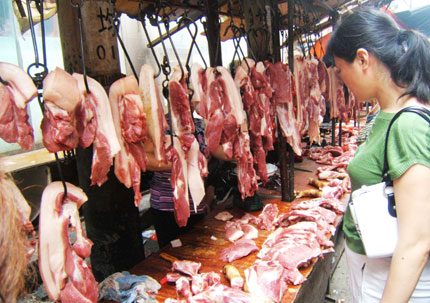
Pork gets the Chop as Prices Rise


The price of Pork in China is soring - what are the implications and ramifications?

The Pork story is a fantastic illustration of just how Chinese economy is set up to cope with the vagaries of capitalism. Terms such as "strategic reserve" show how the old system works and then the fact that many pig farms shut down because of low prices when previously they would have remained open.

Consumers are also having to adapt to rapidly changing prices. What the Chinese are learning quickly is that capitalism has it's down side. A stockmarket crash will ram this home more forcefully when and not if the bubble bursts.

Rising pork prices in China signal pricier times worldwide
The Chinese government is struggling to cope - including deliberating whether to sell a snuffling, smelly strategic reserve of hundreds of thousands of live pigs kept at special subsidized farms for precisely the shortage the country is now facing.

Chinese officials offer several reasons for the high pig prices. The cost of animal feed has risen by one-quarter in the last year, partly because more corn is being made into ethanol and partly because more prosperous workers are eating more meat.

The cost of pig veterinary medicine has soared. Some pig farms, shut down because of low prices last year, were unprepared for strong demand this spring. And outbreaks of disease have killed many pigs, though no reliable estimates of how many are available.

The most recent statistics from the Agriculture Ministry show that prices for live pigs rose 71.3 percent in April from March, while pork prices climbed 29.3 percent. The price of pork followed pig prices higher in May as well, to the dismay of shoppers.

../

The Commerce Ministry keeps a national reserve of frozen pork and live pigs, and local governments keep their own reserves as well, constantly selling older supplies and procuring fresh stock. Government agencies pay a pig subsidy to farmers to keep their animals in the program.

Then there is the knock on effect on inflation:
China's inflation rate hits 27-month high in May
China's inflation in May hit the highest level in 27 months on rising pork and food stuff prices, raising the pressure on the central bank to raise interest rates.

The Consumer Price Index (CPI), a barometer of inflation, rose 3.4 percent compared with the same period of last year, the National Bureau of Statistics said Tuesday, beating the three percent target set by the People's Bank of China for this year.

Other stories:

Pork price rises fuel China inflation fear [Financial Times 28th May]
A disease killing millions of pigs in China has sharply lifted the price of pork, the country’s staple meat, fuelling fears about inflation and prompting a call from the top leadership for increased production of the meat.

Wen Jiabao, premier, provided confirmation of the seriousness of the crisis with a weekend visit to a market in Shaanxi province, where he said farmers should help “resolve the problem” of providing meat for 1.3bn people.

Pork prices have risen by as much as 30 per cent in Chinese cities over the last week. According to the agriculture ministry, wholesale prices for pigs have gone up even more, rising 71.3 per cent since April.


Pig disease sweeps 22 provinces [China Daily 12th June 2007].
The highly pathogenic blue-ear disease hit 22 provinces during the first five months of this year, killing 18,597 pigs, the country's chief veterinarian said yesterday.

Also known as Porcine Reproductive and Respiratory Syndrome (PRRS), the disease was found in 45,858 pigs, leading to the culling of 5,778, said Jia Youling, director of the veterinary bureau affiliated to the Ministry of Agriculture.

"The Economist" on Corruption and the Death Penalty in China

This is a quick link post to provide links to stories from the Economist on Corruption and the death penalty in China. I hope to write longer posts on this topic in the future.

These articles make interesting reading:

A long death row
NO ONE disputes that China is a rising great power thanks to its tremendous economic growth. But an announcement Tuesday May 29th cast several clouds over China’s reputation. The government says it will execute Zheng Xiaoyu, the former head of its food and drug regulator, for corruption. The news represents a remarkable confluence of bad press for China: that high-level corruption is rampant, that its products have killed people and animals around the world, and that the country advertising its “peaceful rise” is a harsh, execution-happy dictatorship.


A mixed picture
China executes more people than all other countries combined: unofficially, as many as 8,000, according to Amnesty International, a human-rights group. While the annual estimated number of executions fluctuates (1,591 in 2006—some 40% higher than in 2003), Amnesty notes that there is a global shift away from the death penalty. The total number of countries carrying out executions has fallen from 40 to 25 in a decade, and 129 countries are abolitionist in practice. America is one of only five democracies still to use the death penalty.


Sinfully rich
FOR all its avowed atheism, China is quite taken with the Christian idea of original sin. The term has become a fashionable one in the state-controlled media, though used almost exclusively in reference to one group of people: wealthy private entrepreneurs. As more prominent businessmen in China fall foul of the law, a debate is raging about whether any of them acquired their wealth entirely legally.

Monday, 11 June 2007

Top Chinese Commercial Cities

Taken from PanAsianBiz this figure provides useful information on the top 25 largest commercial cities.

The main reason for this post is that I am doing some work in this area and this map is a very handy reference that I can refer back to.

Top 25 Commercial Cities in China
Bill Belew May 22, 2007
Know More: All about China China, Commercial Cities, Economy

According to Forbes Inc. the top 25 Commercial Cities in China are:
Shanghai Guangzhou Ningbo Hangzhou Yantai
Jinhua Beijing Jinan Dongguan Shenzhen Wuxi Tianjin Fuzhou Yueyang Dalian
Nanjing Wuhan Qingdao Chengdou Wenzhou
Suzhou Zhanjiang Wulumuqi Weihai Xiamen

Trade Growth - beats economist's forcasts

This is impressive growth by any standard...

---------------------------

June 11 (Bloomberg) -- China's trade surplus rose a bigger- than-estimated 73 percent in May from a year earlier, increasing pressure on the government to allow faster currency gains.

The gap widened to $22.45 billion, the customs bureau said on its Web site. The median estimate of 18 economists surveyed by Bloomberg News was for a $19.5 billion surplus. For the first five months, the surplus grew 84 percent to $85.72 billion.

Surging exports spurred economic growth of 11.1 percent in the first quarter and drove foreign-exchange reserves to a record $1.2 trillion.

http://www.bloomberg.com/apps/news?pid=20601080&sid=aPeVuVWp4mSE&refer=asia

Sunday, 10 June 2007

Overseas Education and Job Prospects in China

This blog continues to assess the economics of Chinese students undertaking an overseas education. The merits of taking postgraduate education abroad are numerous including language skill and receiving a top quality education.

However, the number of applicants from China to UK Universities for example has been falling in the last few years by between 10 and 20% a year by my rough estimates.

One reason that I have always suspected is the state of the domestic job market relative to the high costs of studying in the US or UK. With more and more overseas graduates with PhDs, MBAs and MSCs and increasing competition from domestic graduates, starting salaries are often not reaching expectations and are certainly not sufficient to pay of the large debts accrued during their study period.

Some of the quotes from the article below are worrying - if the UK wants to continue to attract the best Chinese students they must ensure that they are offering a quality product that allows the student to differentiate themselves from the domestic graduate.

My last post on this issue was a couple of days ago:
High Education Costs, Low Executive Pay

The latest article on this topic comes from CRIEnglich.com. H/T: PanAsianBiz.

Overseas PhD Students Upset at Salary Offers

Some job hunters who attended the first special job fair for Chinese overseas students in Beijing on Sunday were disappointed to learn salaries offered were much less than they expected.

The Beijing Morning Post reported that more than 40 reputed enterprises and public institutions, such as Beijing Organizing Committee for the Games of the XXIX Olympiad (BOCOG), Chinese Academy of Social Sciences, Peking University and Chinese computer giant Lenovo joined in the job fair looking for qualified talents.

The fair attracted more than 2,000 job hunters holding advanced academic degrees issued by overseas universities and colleges.

However, although they held master or PhD degrees, the job hunters found many of employers only offered month salaries as low as 3,000-yuan (about 375 US dollars), almost equivalent to those offered for bachelors who graduated from a domestic university.

After nearly one-hour's search, Yu Yang, who got a MBA degree from a British university, said it was hard to find a satisfying job.

"I expect a monthly salary of around 8,000 yuan (some 1,000 US dollars). But what the employers offer is much lower than that," Yu Yang said. "It is imbalanced compared to the cost I spent studying abroad for two years - a sum about 500,000 yuan or above 64,000 US dollars."

A recruiting official from Beijing University of Posts and Telecommunications said the institution is inclined to recruit degree holders who have returned from overseas because they "usually possess an international view".

"However, we offer the same benefit package to employees in the same posts, no matter if they studied at home or abroad," the official said.
"The salary offered for some candidates with doctorate degrees is about 3,000 yuan per month."


Degree holders who return from abroad are increasing, said another employer.

"They do not have many advantages now," the employer said. "We will not favor a candidate just because he or she returns from abroad. We attach more importance to their capacities and work experience."

Friday, 8 June 2007

"China bubble" - the political dangers ahead

The Chinese stock market bubble has slowly re-inflated itself after last week's share sell off. The Chinese government is in a quandary. If it lets the bubble inflate further the eventual crash will be severe. If it acts now it will get the blame for investors losses.

The true economic costs may be limited. However, the political ramifications may be far greater. My bold highlights.

Today's FT has an excellent article on this topic. We have previously covered a lot of the points raised here regarding the hundreds of thousands of small investors etc. The key here is to think "politics" (see the Stock market tab in the sidebar for previous posts).

I like this quote from the article:
"Only the government knows how the stock market will develop next. The government decides everything. We are helpless, helpless."

As stocks falter, Beijing mulls the chances of an investor backlash
The remarkable rise of China's stock market in recent months has left the government mulling two bad alternatives: let the market surge too high and the subsequent crash would be ferocious; but act too aggressively to cool it down and the authorities would be blamed for the losses.

With the Shanghai exchange again showing signs of fragility since the government increased the tax on share trading last week, there are many reminders that if the market turns sour, investors will consider it the government's fault.

Three years ago, when discontent was spreading among ordinary investors after a prolonged slump, one man set himself on fire outside the regulator's Beijing headquarters, while the manager of a beauty products company in southern China called in two bomb threats to the same building.

These stories are an indication that although the Chinese economy could easily emerge unscathed from a further plunge in the stock market, the political consequences are potentially much larger.

"In the case of a severe correction, this could lead to social instability," said Dong Tao, an economist at Credit Suisse. Some observers have even pointed out that market crashes in other developing economies - especially in post-Communist countries - have ended up undermining a whole generation of economic reformers.

The new bout of turbulence in Shanghai has brought to an end one of the more remarkable episodes in the history of stock markets. In an atmosphere that sometimes resembled a gold-rush, several hundred thousand new share trading accounts were being opened every day in April and May. Share prices became a staple of daily conversation, not just for urban professionals but also for domestic cleaners, janitors and sweet-potato sellers on street corners.

The influx of these new investors helped push share prices to record highs, a fourfold increase from the middle of 2005, and spawned myriad tales of (almost) overnight millionaires.

The popular frenzy over share trading led the government to intervene last week, trebling the tax on share trading. Just over a week later, the authorities are likely to be comfortable with the situation. After a 3 per cent jump yesterday, share prices have now fallen 10 per cent from their high last week since the stock tax was increased and trading volumes are considerably lower, indicating that some of the frenzied speculation of the last two months has disappeared.

However, further sharp declines cannot be ruled out. "If it falls 30 per cent, that would be the moment that warning bells would go off in Beijing," says Stephen Green, an economist at Standard Chartered in Shanghai.

The potential political problems from a 30 per cent drop in the market have been amplified by the scale of the current boom. At the height of the last bull market in 2000-2001, there were around 60m trading accounts. Now there are more than 100m.

A 30 per cent drop would bring the market down to around 3,000 points, a level it last saw on March 19. Since then, more than 17m new trading accounts have been opened, many of which would be showing losses.

The new investors range across all age groups. Brokerage houses in big cities are full of pensioners who treat playing the market as a new career, while so many students have been trading stocks that the education ministry put out a warning telling them to concentrate on their studies.

With the Communist party holding an important congress in the autumn to discuss top leadership positions and the Olympics next year, Beijing will not want to galvanise the middle class against the status quo.

As well as the potential for discontent from middle-class investors, a sharper fall in the market would also damage the government's plans for financial reform. Over the last two years, Wen Jiabao, the prime minister, has made one of his priorities the creation of a strong capital market in order to take pressure off the banks, promote more stable economic growth and to provide a platform for the development of pension assets.

One part of that strategy was to encourage citizens to put some of their bank deposits into equities and bonds. However, if the new retail investors end up with heavy losses, it could push back reform several years.

In recent days, it has not been hard to find disgruntled small investors who say they have been put off investing. Internet chatrooms have been full of outrage at the tax rise. "The only thing I have to say is that China is not a market economy," said a man with the surname Wu as he came out of a Shanghai brokerage earlier this week. "Only the government knows how the stock market will develop next. The government decides everything. We are helpless, helpless."

There could also be pressure on the government to bail out various parts of the public sector. While the small investors have been grabbing all the attention, some analysts believe there have been much bigger investments by state-owned companies, local governments, the police and the army.

Most of these investments are hidden - one of the few public examples is the Shanghai agency responsible for housing maintenance, which appears on the list of 10 largest shareholders for three listed companies. But Fraser Howie, co-author of a book on the Chinese stock market, argues that the investments by these government bodies could account for half of the traded shares.

Yet even though the authorities could face an uncomfortable backlash from some investors if there is another sharp drop in share prices, few China-watchers believe that the stock market has the ability seriously to undermine the government and generate broader political instability.

For a start, the number of small investors is probably much lower than implied by the figures for trading accounts. Many investors open two accounts - one at the Shanghai exchange, the other at the Shenzhen exchange. Moreover, a large proportion of the accounts are dormant. The number of people actively trading in shares could be as low as 10-20m.

Moreover, while there are cases of people pawning their houses to buy shares, the Chinese middle class has substantial savings to fall back on in the event of a stock market meltdown. Personal bank deposits in China are currently worth around $2,000bn (£1,010bn, €1,490bn).

"We are highly sceptical about the idea of a serious middle-class political backlash in the current environment," says Andrew Gilholm at Control Risks, the London-based consultancy. "The middle class consists of people whose lives have improved very significantly under the Communist party reforms. They are winning, so why rock the boat now?"

Wang Yuanqing, who spends his days investing at a Shanghai brokerage and giving advice to other small investors, is relaxed about the recent setback and takes a long-term view of the market. "After the rise over the last two years, I personally think the latest adjustment is very reasonable," he says. "The majority of investors have still made money."

Copyright The Financial Times Limited 2007

Thursday, 7 June 2007

Climate Change Spotlights: Conservation International highlights China

Today saw the release by Conservation International of a list of 20 locations to highlight the impact of climate change.
"These 20 locations are a selection of examples, drawn from the expert opinion of our top climate change scientists, that illustrate the various impacts climate change is already having on life, both wild and human, across the planet."


Included are the regions you would expect, the Arctic, the Amazon, the Congo etc.

One of those locations highlighted is "China" with the following accompanying photograph and text. The bold type is mine.

I have posted before under the "environment" tab in the sidebar on the potential economic impact of climate change and pollution on Chinese growth. It is not something to be underestimated. My belief is that the Chinese government is well aware of this fact but faces a difficult balancing act between growth, poverty alleviation and limiting greenhouse gas emissions and other pollutants.

This article paints a rather bleak picture.


China
Just several years ago climate experts estimated China would surpass the United States as the world’s largest emitter of greenhouse gases by 2025. Now the experts say this will occur by 2008. A new coal plant is built every week, and some 14,000 cars are added daily to already-congested urban roads. China has 16 of the 20 most polluted cities in the world and more than a million Chinese die from respiratory diseases each year.

The haze also compromises economic security by blocking sunlight and impeding crop growth. Scientists believe severe floods in southern China and extreme drought in northern China may be a result of black carbon soot released from burning crop residues and coal-burning operations. Drought has desiccated 267,000 square kilometers of agricultural land, and desertification afflicts some 3 million square kilometers of mainly grasslands, with winds whipping sandstorms that travel all the way to North America.

At the same time, portions of this landscape are considered the most botanically rich temperate region in the world. Even though the species richness is not fully documented, diversity of vascular plants is estimated at around 12,000 species, representing as much as 40 percent of all the species in China. Of these, about 30 percent are endemic. The mountains of Southwest China also provide habitat for golden monkeys (Rhinopithecus roxellana), giant pandas (Ailuropoda melanoleuca), and a number of pheasants – all are threatened species found nowhere else on Earth.

Illegal hunting, overgrazing, and firewood collection are some of the primary threats to biodiversity in this region. The construction of the largest dam in history – the 18,000-Megawatt Three Gorges Dam on the Yangtze River – has already and will continue to heavily threaten the biodiversity of this region. China has additional plans to construct the equivalent of a Three Gorges Dam every 16 months over the next decade or so. The Yangtze is also home to the baiji or Chinese river dolphin (Lipotes vexillifer) – one of the most threatened dolphin species in the world – which is now on the verge of being lost forever.

China’s massive population of 1.3 billion people has exacerbated pressures on the environment and has also made more people vulnerable to the effects of climate change. Scientists project that sea levels will increase dramatically – anywhere from one to six meters – in this century. This will no doubt put coastal cities, agriculture, livelihoods, and infrastructure at great risk. China is among 10 countries with the largest number of people threatened by rising sea levels.

The more Earth’s climate changes, the worse China’s water crisis becomes. Western China’s glaciers have shrunk by one-fifth, threatening the water supply for a quarter of a billion people. The country is already plagued by a severe water shortage brought on by inefficient irrigation systems, where nearly two-thirds of water fails to reach crops. The shortage is exacerbated by severe water pollution; more than 70 percent of the country’s untreated wastewater is discharged directly into rivers.