Saturday, 30 June 2007

Life in China: recycling for a living

This post from Ben at Ben's Blog "A Midwesterner in the Middle Kingdom" provides an interesting insight into the hidden or not so hidden economy of China's growing cities.

It makes an interesting contrast to jump from "stock market frenzy" to how many Chinese make a living and survive on less than a dollar a day recycling other people's rubbish. As a side issue China's economy can only benefit from such activity - the problem will come when the Chinese become too wealthy to indulge in such activity and follow the West down the road to becoming a disposable society.

Ben has an excellent writing style and the blog is always interesting. I must add it to my blog roll if it is not already there.

Professional Recycling

One summer when I was 10 years old, I heard a rumor at summer camp that there was a grocery store in my neighborhood which would pay cash for recycled aluminum cans. For the next 4 weeks, I collected all of the aluminum cans from fellow campers until I had nearly filled an entire garbage bag. At the end of the summer my dad took me to the grocery store. I proudly showed the clerk my bag full of cans which was nearly half my size. He told me I was a responsible little boy for caring so much about the environment, and then handed me $1.29 cash for my summer worth of can collecting.

5 years later, I started my first real job, working as a sacker in a local grocery store. I was paid $4.25 per hour, which was the minimum wage in Kansas at the time. It didn’t take me long to figure out that labor is worth more than materials in the USA.

While I was working at the barber shop, three or four times per day, a middle aged man or woman would rummage through the trash can in front of the store. There was a man who would collect bottles and cans, a woman who would collect the plastic disposable cups we used to serve the customers water, and there was even a lady who would come every few days to collect all of the hair. By the end of the day, there was hardly anything left in the trash.

To a casual observer, these people might seem to be beggers. Fuzhou does have its share of panhandlers, but these are not the same people who are digging through the trash Rather, the people who collect our disgarded items are professional recyclers.

In Fuzhou, recyclers can collect .07 RMB for an aluminum can and .1 RMB for plastic bottles. At this rate, it would take about 109 aluminum cans to equal 1 US dollar. This rate is not too far off the one I was given that summer I collected cans at camp. The return is still not high, but when you consider a low-level service industry job requires 4 hours of work to earn 1 US dollar, the prospects of making a living off of recycling suddenly become more attractive. Add that China’s densely populated cities make the process of bottle collecting more efficient than they would be in the US, and it is not surprising why professional recycling is such a common profession in China.

In addition to recycling cans and bottles, professional recyclers also collect and/or buy used electronic devices, books, magazines, cardboard, CDs, and virtually anything else which at some time had value. Some of it is resold, and some is broken down for scrap. The recyclers ride their bikes through city streets with big signs placed in front of the handle bars which read 高价回收 (high price recyclying) and contain a list of items (usually household electrical appliances) which they will buy.

The future will only tell how much longer recycling will remain a profession in mainland China, and presumably as the price of labor rises, the draw to professional recycling will recede. But as barbershop workers are still making only 24 cents an hour, recycling stands to remain a viable profession for the near foreseeable future at least.

Thursday, 28 June 2007

Will a savings tax slow the stock market frenzy?

With the bubble continuing to inflate it is clear that certain elements of the underlying structure of the Chinese economy are to blame. The bottom line appears to be a shortage of alternative assets for the local Chinese to invest in (for example, overseas shares, real estate).

The latest idea is to abolish the savings tax to encourage individuals to keep their savings in accounts instead of throwing it at the seemingly one way street that it is the Chinese stockmarket.

With increasing inflation means that real returns are close to zero the Chinese government has a long way to go to turn around the stockmarket juganaught.

The Independent summarise the current proposition:

China to act on savings tax to deter share-buying frenzy
Chinese regulators are considering suspending or abolishing a 20 per cent tax on bank savings to try to persuade consumers to stop moving cash out of bank deposits into the increasingly heady world of stock market investment.

Rising inflation is badly eroding the value of savings in China, where people tend to save as much as 40 per cent of their income in the absence of a solid social welfare system.

This has helped to fuel a boom in share buying, which has replaced bank saving as the most popular investment option in China and stoked fears of an unsustainable bubble. The country's stock market rose 130 per cent in 2006 and by over 50 per cent already this year, despite some vertigo-inducing corrections that have caused ripples around the world.

China has seen the introduction of record numbers of new share-trading accounts which now add up to over 100 million. A central bank survey last month showed that consumers now prefer shares to deposit accounts.

The regulators hope that changing the tax, first introduced in 1999, would make saving in banks more attractive. JP Morgan economists said removing the tax would be the equivalent of a 60 basis point rate rise for savers.

The move into share ownership has been driven by ordinary investors, such as former State-owned Enterprise (SOE) employees, students and fledgling business people in the booming "New China".

These investors are unable to invest in property but are unhappy with the returns they are getting on their bank deposits, because rising inflation has brought real deposit rates close to zero. Rising food prices in China have seen CPI creep up to 3.4 per cent in May.

The benchmark one-year deposit rate is now 3.06 per cent, just slightly higher than the 2.9 per cent rise in the consumer price index to May this year.

"What's really happened is a shift out of long-term savings deposits in favour of more liquid short-term deposits," said Jonathan Anderson, chief Asia economist at UBS in Hong Kong.

"The domestic stock market has been booming, with a sharp rally in March and April; [and] households and firms liquidated longer-term deposits to buy equities," said Mr Anderson.

Finance Minister Jin Renqing said the government had decided to look into the issue in the light of a booming economy.

Wednesday, 27 June 2007

How to Win the China Piracy Battle

From the inbox:

This is an interesting article from Shaun Rein at Business Week:

How to Win the China Piracy Battle

As Shaun correctly identifies, economics plays a crucial role in the demand for and the supply of pirated goods. Where I would take issue is that even if counterfeiting was removed entirely as of tomorrow it would make only a small dent in the US trade deficit and not as has been written "a long way to reducing the deficit".

The bottom line is that China is still developing and at this stage of development with per capita incomes still so low piracy is inevitable. As China gets richer demand for authentic goods will increase and the problem will solve itself. Meanwhile Western multinational need to take a pragmatic approach and consider their pricing policies. Creating brand loyalty now will pay off in future years. Indeed, the owners of fake Rolex watching will be constantly dreaming of the day they can afford a real one.

A Matter of Economics

First, multinationals should try to stop the piracy by taking a business approach rather than a legal or moral one. They must become less moralistic about intellectual property theft by the Chinese. While they do have the legal high ground, their current posturing does little to stop the pirates or generate revenue from legitimate sales.

The problem is more a matter of economics than of a morally corrupt Chinese populace. As the disposable incomes of Chinese consumers continue to grow, brand loyalty gains currency, and domestic Chinese companies begin to lose revenue to pirates, intellectual property problems will be solved in much the same way as they were in Taiwan and Korea. Smart multinationals will make sure they are in a strong position to reap the benefits in China.

One positive sign is that Chinese are in many ways no different from other consumers. Millions are entering the ranks of the middle class, and they want to look the part of the urban aristocrat. If they cannot afford genuine items they turn to touts on the street hawking fake Louis Vuitton, Tiffany (TIF), Montblanc (CFR.VX), Rolex, and Polo (RL) items. But as Chinese consumers become increasingly sophisticated, the situation is changing. Now consumers can value the difference between a real Giorgio Armani tie and a fake one.

Saturday, 23 June 2007

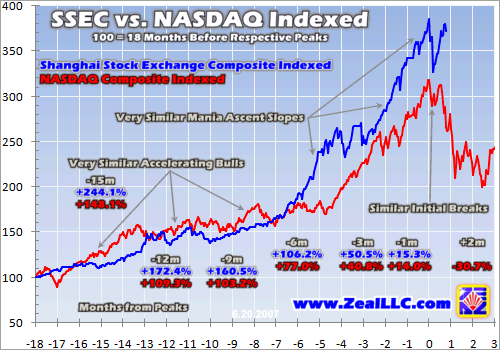
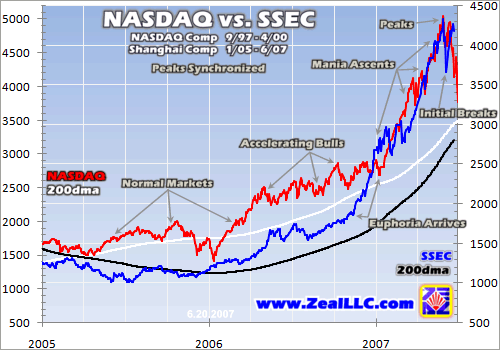
China 2007 vs. NASDAQ 2000 - ZEAL analysis

Interesting post from 22nd June comparing the NASDAQ in the year 2000 and the current Chinese stockmarket.

China 2007 vs. NASDAQ 2000

Whilst there are significant differences in the structure the similarities in the figures makes this a compelling little story.


All stock manias must come to an end as exponential price growth is inherently unsustainable. Eventually the public has bought all the stock it can buy so there are no untapped pools of capital left to bid on stocks. At this point the whole house of cards starts to implode. The SSEC’s behavior in the last month mirrors the NASDAQ’s around its own March 2000 top remarkably well. Caveat emptor.


H/T China thread on ADVFN.


Friday, 22 June 2007

Who is really inflating the bubble II: Warning on illegal Shanghai share deals

On the back of a previous post on this blog:

Who is REALLY inflating the "Chinese Stockmarket Bubble"?

comes an article from the Financial Times that sheds a little more light on the subject.

Warning on illegal Shanghai share deals

State-owned companies and government agencies in Shanghai, including those responsible for education and pensions, misappropriated Rmb6.3bn for illegal investment in the stock market over the past three years, according to a senior judge at the city’s highest court.

Qi Qi, deputy director of the Shanghai High People’s Court, said the diversion of funds into equities was the result of weak controls over public spending and could undermine confidence in the stock market.

“This is becoming a major threat to the stability of the market and to investment funds,” he said. “Moreover, the volatility of stocks can cause huge losses for public finances.”

His outspoken comments are the most authoritative confirmation yet that the spectacular boom in the mainland stock market over the past two years is not just the result of funds coming from millions of new individual investors, but also reflects large speculative investments by different branches of the government.

Chinese share prices are up 60 per cent this year, on top of 130 per cent in 2006.

Fraser Howie, co-author of a book on the Chinese stock market, believes undisclosed public investment in equities could be as high as $125bn (€93bn, £63bn) although he says it is impossible to prove the figures.

Economists fear that a substantial stock market fall could lead to calls on the authorities to bail out different government units.

“There has not been any effective mechanism in the country to supervise the operation and management of public funds, and as a matter of fact it is difficult to curb their malpractices,” Mr Qi said. The judge said the figures were based on an analysis of 105 embezzlement cases accepted by Shanghai’s courts between 2003 and 2006. About Rmb4.1bn ($539m, €402m, £271m) of the illegally invested funds had come from 69 different state-owned companies.

The other government units involved included agencies responsible for social security, education, housing maintenance and public utilities. Most are allowed to put some funds into government bonds, but not equities.

Mr Qi’s comments were initially made to a number of Chinese newspapers at a briefing on Tuesday. The court yesterday confirmed his comments and said they were a warning to investors about the potential risks in the market. The Shanghai government did not respond to requests for comment.

The revelations by the court follow a corruption scandal in Shanghai last year where officials were accused of siphoning off part of the city’s pension fund.

Earlier this week the banking regulator said it would fine eight banks for lending Rmb5.1bn to two Chinese state-owned companies, which had illegally used most of the funds to invest in equities. The announcement was seen as a warning to other companies.

Copyright The Financial Times Limited 2007

The problems that a share price collapse could have on other Chinese institutions could have serious knock on effects for political economy.

If, as assumed, the Chinese government will simply step in a bail out these government departments the incentive mechanisms are all wrong. The upside is huge and the downside is limited. The government needs to take action to curb this behaviour even if the result is a fall in share prices in the short term.

Thursday, 21 June 2007

Beware the dragon: A booming China spells trouble for America.

I believe it is useful to get a US perspective on China's rapid growth. US-China relations are strained and will continue to be so especially as China continues to secure access to raw materials via links to Africa. The following links from my inbox provide interesting listening and viewing:
The debating society Intelligence Squared U.S. held a session last month on the motion: "Beware the dragon: A booming China spells trouble for America." Bill Gertz, Johm Mearsheimer and Michael Pillsbury spoke for the motion. Daniel Rosen, James McGregor and Stapleton Roy spoke against. James Harding of the Times of London served as moderator. A live audience of about 300 at Asia Society, New York City voted 35% for the motion and 59% against at the conclusion of the debate. Six percent (6%) were undecided.

The audio may be accessed here: http://www.intelligencesquaredus.org/Event.aspx?Event=15

Video may be viewed here: http://www.youtube.com/view_play_list?p=7553C3DB04C6C19A


It is interesting to have a look at the profiles of those for and against the motion:

FOR THE MOTION

Bill Gertz is the defense and national security reporter for the Washington Times and the author of several books, including Enemies: How America ’s Foes Steal Our Vital Secrets—and How We Let It Happen and The China Threat: How the People's Republic Targets America. He is also an analyst for Fox News and has been interviewed on many news programs.

John J. Mearsheimer is the R. Wendell Harrison Distinguished Service Professor of Political Science and the co-director of the Program on International Security Policy at the University of Chicago, where he has taught since 1982. Professor Mearsheimer has written extensively about security issues and international politics. He has published three books, including Conventional Deterrence and The Tragedy of Great PowerPolitics.

Michael Pillsbury is a consultant to the Office of the U.S. Secretary of Defense on future planning issues. He has advised the Pentagon for more than three decades on subjects such as Asian affairs and long-term defense planning. He spent several years at the Rand Corporation and the National Defense University . Pillsbury has also served on the faculties of UCLA, USC, and Georgetown University , teaching East Asian politics.


AGAINST THE MOTION

Daniel H. Rosen is the Principal of China Strategic Advisory, a specialized practice helping decision-makers in the public and private sectors analyze and understand commercial, economic and policy trends in China. He is also an Adjunct Associate Professor at Columbia University and a Visiting Fellow with the Institute for International Economics. As Senior Advisor for International Economic Policy at the White House National Economic Council, he played a managing role in China ’s accession to the World Trade Organization.

James McGregor has served as a key advisor to both the U.S. and Chinese governments. A Mandarin speaker, he was the Wall Street Journal's China bureau chief following the 1989 Tiananmen Massacre, the chief executive of Dow Jones' China business operations during much of the 1990s, and a venture-capital investor during China's dotcom boom. McGregor is the author of One Billion Customers: Lessons from the Front Lines of Doing Business in China. He is also a former chairman and governor of the American Chamber of Commerce in China.

J. Stapleton Roy was promoted in 1996 to the rank of career ambassador, the highest rank in the U.S. Foreign Service. Fluent in Chinese and a specialist in Asian affairs, Ambassador Roy rose to become a three-time ambassador, serving in Singapore, the People's Republic of China, and Indonesia. Roy served as Assistant Secretary of State for intelligence and research from 1999 to 2000. He is currently a managing director of Kissinger Associates, Inc.


I must admit to being a little surprised but mildly impressed that the motion failed given the US audience and the recent press coverage of US-China relations. Perhaps there is hope after all.

Environmental Round-up for June

The globalisation and environment blog have a good round-up of China related environmental stories including coverage of the news that China has overtaken the US s the world's largest polluter ahead of expectations.

More researh is required into the so-called pollution haven effect where the west exports its dirty productive capacity to China either explicitly (MNEs actually moving production) or implicitly (China simply replacing Western production due to lower costs).

China the World Leader for CO2 emissions + China round-up